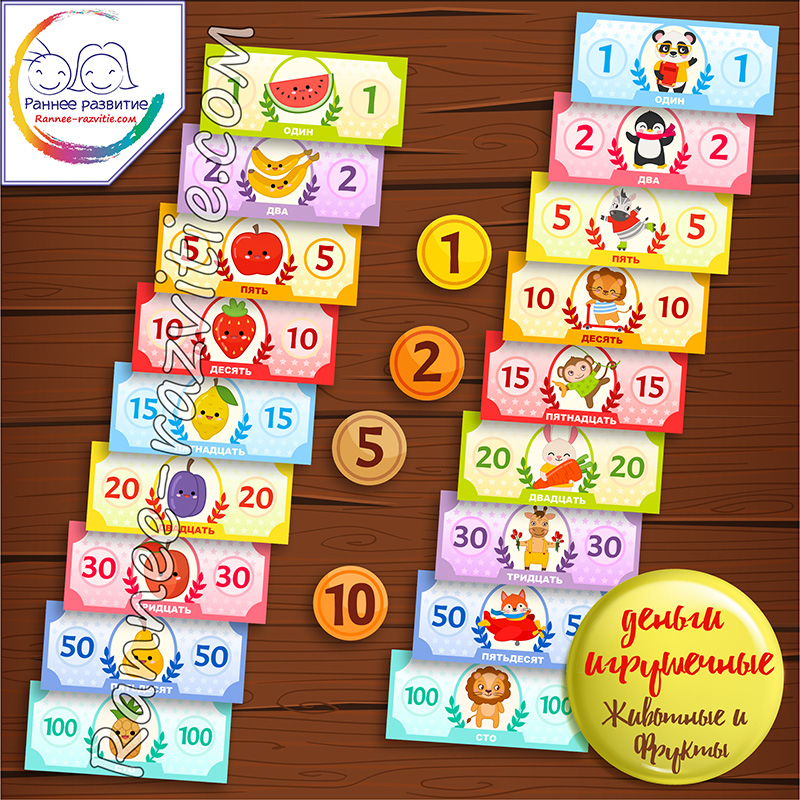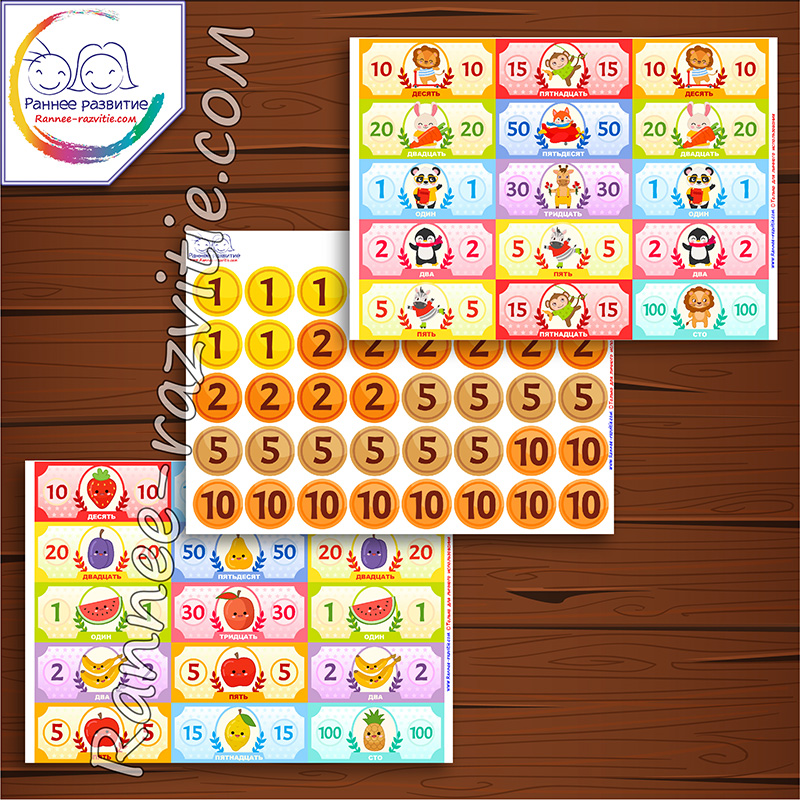

Toy money

Material author: © Margarita Barilskaya

No ratings yet

What is the purpose of the “Toy Money” game set?:

Children love to play “shop” and other games related to money and shopping. If you want your child to be able to handle money responsibly and wisely over time, he should have as many of these games as possible.

This set, which consists of toy banknotes and coins for entertaining and educational games on financial literacy, will help you organize and conduct such games.

The play set will help your child develop financial literacy, imagination, and communication skills. And also understand the value of money, learn to distinguish between the denominations of banknotes and coins, and differentiate them by value. Introduces the concepts of absolute and relative cost (more expensive - cheaper).

While playing at the store, the child will learn to count in his head and quickly separate the required number of coins and bills to pay for goods at the checkout. And also determine whether the seller gave the change correctly. The game trains logical thinking, attentiveness and reaction speed.

For the board game of shopping, you will need not only toy money, but also cards with images of the goods themselves.

You can find the necessary templates on our website:

Modular didactic game “Groceries Store”

Velcro game “Shoe store”

Velcro game “Lay out the food”

A selection of Velcro games on various topics “Educational Lotto”

Material description

How to play?
First, you need to come up with a game for children in which they will use coins or paper money. For example, this could be a game of grocery or clothing store, or a game of bank.
Then you need to assign roles. For example, between a buyer and a seller (if you play the store) or between a bank employee and a visitor (if you choose to play the bank).
You can come up with several options for playing shop that will help your child feel like he’s on both the buyer’s and the seller’s side.
Additional visual material is required for the game. Any pictures or cards depicting a particular product will do.
1) Didactic game “Buy a product.”
Lay out product cards and price tags for them in front of the child. Ask him to buy everything, from the cheapest to the most expensive. The child must independently select the required number of bills and coins and pay for the purchase without change.
2) Didactic game “Buy everything”.
Take several product cards (first 2, then 3 and finally 4).  Select the required number of bills and coins for each card to pay for goods without change. Then mix the money and put it in one pile. The child’s task is to correctly distribute the bills and coins among the product cards so that they can buy them all, paying for each individual purchase without change.
3) Didactic game “Sell the product.”
Divide all the money into two parts so that the majority remains with the child. Place the product cards on the table. In this game, the child performs the function of a seller: buy goods from him, giving amounts exceeding the price tag, so that the child will give you change.
4) Didactic game “Buy and sell”.
Divide all the money into two parts so that the child retains most of it. Place the product cards on the table – half for you, half for the child. Take turns buying cards from each other. Try to give amounts that exceed the price tag so that your child will give you change.
How to make a game?
Print materials on thick photo paper. Laminate for durability and reusability.

Comments and ratings

No ratings yet